


Most people looking at an antique clock begin with the face. That is where the eye goes first. Numerals, chapter ring, hands, signature, a little wear around the winding holes. The dial seems like the public part of the clock, the part that tells you what sort of object you are dealing with. Yet behind that visible surface are small fixings that most owners never see. Among them are the dial feet.
Dial feet are small metal posts attached to the back of the dial. They pass into or through the movement plates and help hold the dial in the correct position. On some timepieces they are secured with pins, screws or small clamps. They are not glamorous. They do not tick, strike or shine. But without them, the dial is no longer quite as settled as it appears from the front.
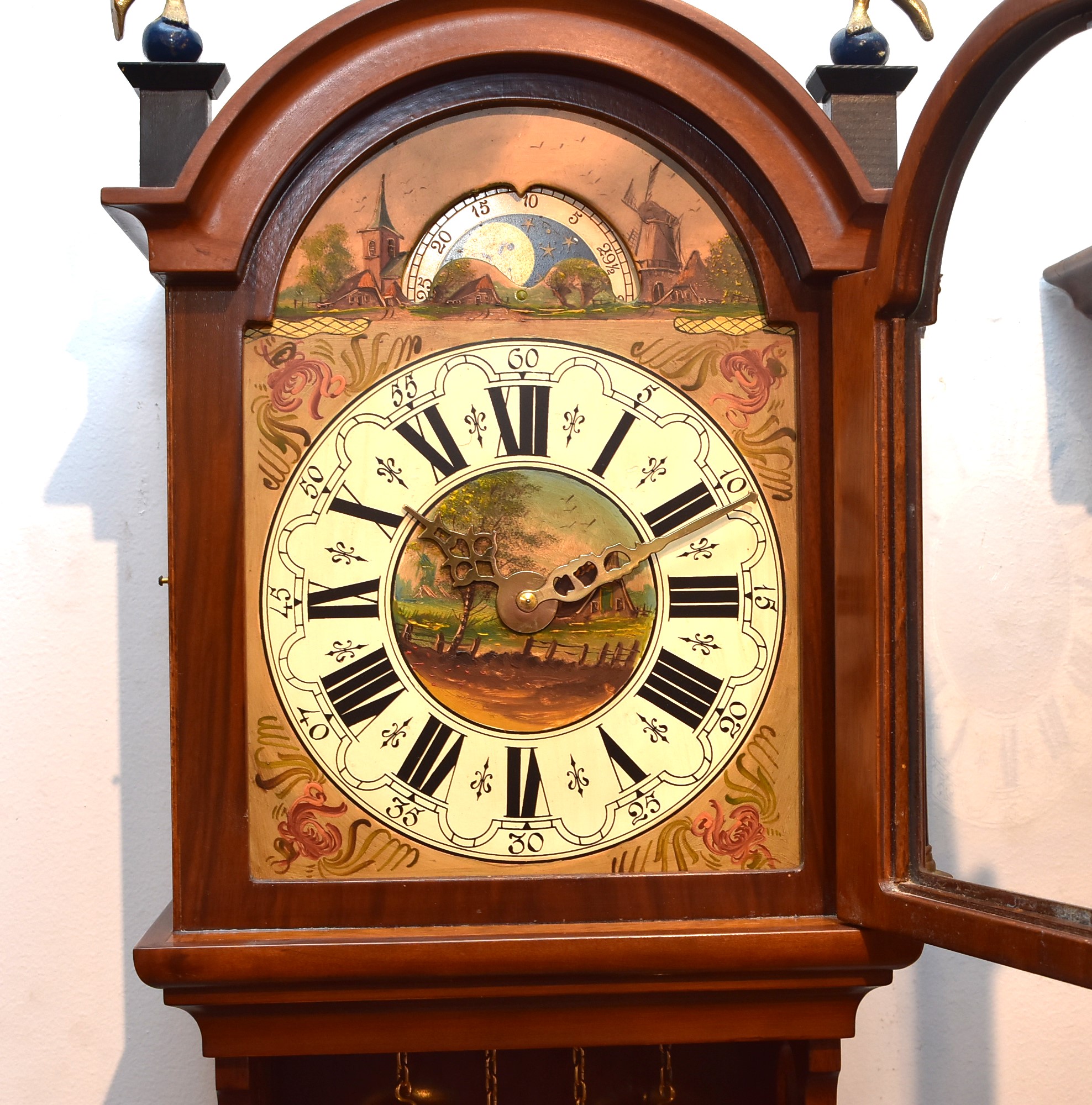
That matters because the dial is not just decoration. It has to sit correctly in relation to the movement. The centre hole must align with the hand arbor. The winding holes must meet the winding squares. The hands must have enough clearance to move without scraping the dial or catching each other. If the dial shifts even slightly, the whole front of the clock can begin to feel wrong.
A loose dial foot may cause nothing dramatic at first. The clock may still run. The hands may still turn. But the dial can sit with a faint lean, a tiny wobble, or a small loss of confidence. The owner may notice that the winding key no longer finds the square cleanly, or that the minute hand seems too close to the painted surface. Sometimes the problem appears only when the clock is moved, cleaned or wound.
This is where dial feet show how stability in a clock is not only about the famous parts. We tend to think of stability in terms of pendulums, escapements, weights and springs. Those are important, of course. But a clock also depends on quiet alignment. The dial, movement and case need to agree with one another. Dial feet are part of that agreement.
They can also tell a restorer something about the clock’s past. A missing or badly repaired dial foot may suggest that the dial has been removed many times. A foot in the wrong position may indicate that a dial has been adapted to a different movement. Fresh solder, odd holes, modern adhesive or improvised brackets can all point to earlier repair decisions. None of this automatically condemns the clock. It simply says something about the clock’s history.
There is a temptation, especially with a beautiful old dial, to judge only what can be seen from the front. That is understandable. A good dial has presence. It may carry age beautifully, with softened silvering or paint that has mellowed rather than failed. But the back of the dial can be just as revealing. It is less polite. It shows repairs, compromises and the practical means by which the clock has stayed together.
For a buyer, dial feet are not usually the first thing to ask about. They are not as obvious as a replaced hand or a damaged case. Still, they deserve attention, particularly when the dial does not sit squarely, the winding holes seem slightly out of place, or the front plate feels insecure. A clock that looks calm from across the room may be relying on a rather awkward repair behind the dial.
Repairing dial feet is delicate work. On enamel, painted or silvered dials, heat and pressure can cause damage if handled carelessly. In some cases a foot can be reattached. In others, a more sympathetic method may be needed to secure the dial without pretending that nothing ever happened. The best repair is not always the most invisible one. It is the one that makes the clock stable while respecting what remains original.
That is why dial feet are worth noticing. They are tiny parts with an unromantic job, but they help preserve the relationship between the face of the clock and the movement behind it. It is a little like health: when everything is sound, nobody thinks about it. When something fails, the whole object can lose a little of its composure. In a worse case, the trouble is serious.